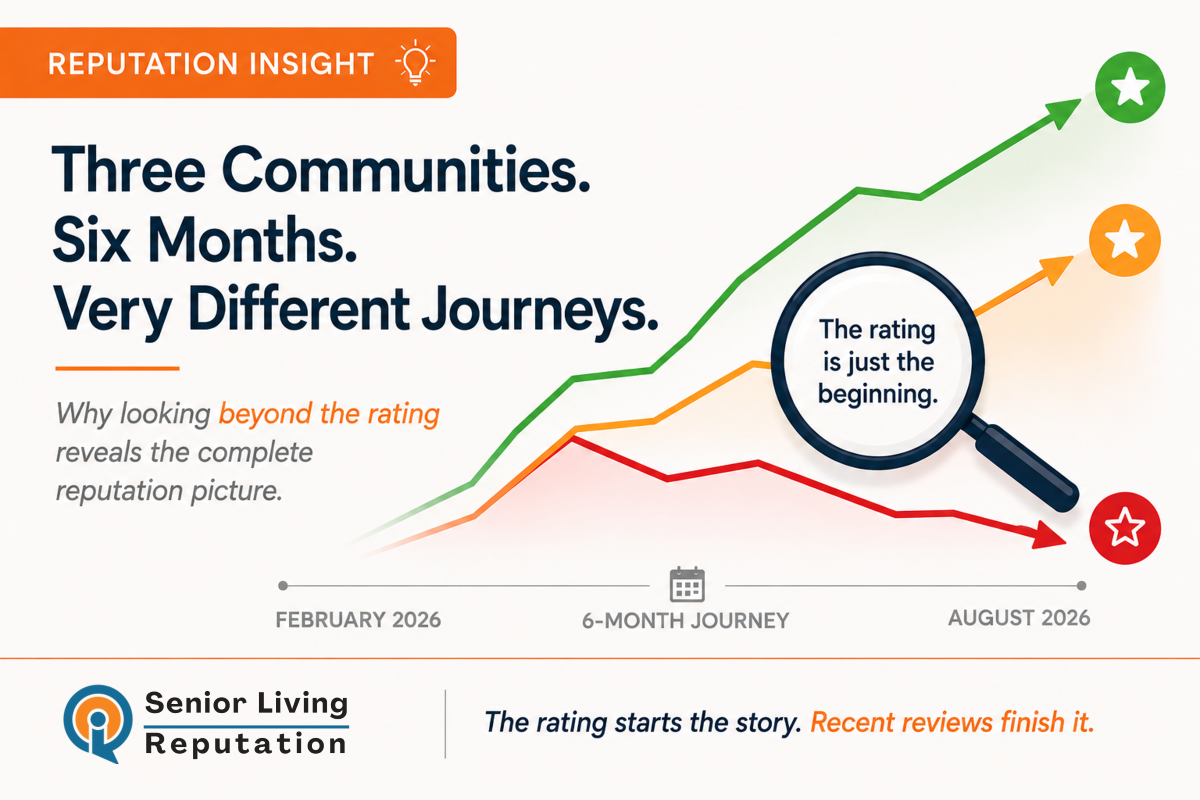
Google ratings are one of the most valuable tools families have when researching senior living communities. They provide an easy-to-understand summary of years of resident and family experiences, making them an excellent starting point.
But because Google ratings are cumulative, they don't always reflect what's happening today.
Communities can improve faster than their ratings.
Likewise, changes in resident experience can begin showing up in recent reviews long before they're fully reflected in the overall rating.
This month, we looked at three real communities whose six-month journeys illustrate why understanding reputation momentum can be just as important as understanding reputation history.
Our first example is StoryPoint of Hixson North(formerly Dominion Senior Living of Hixson).
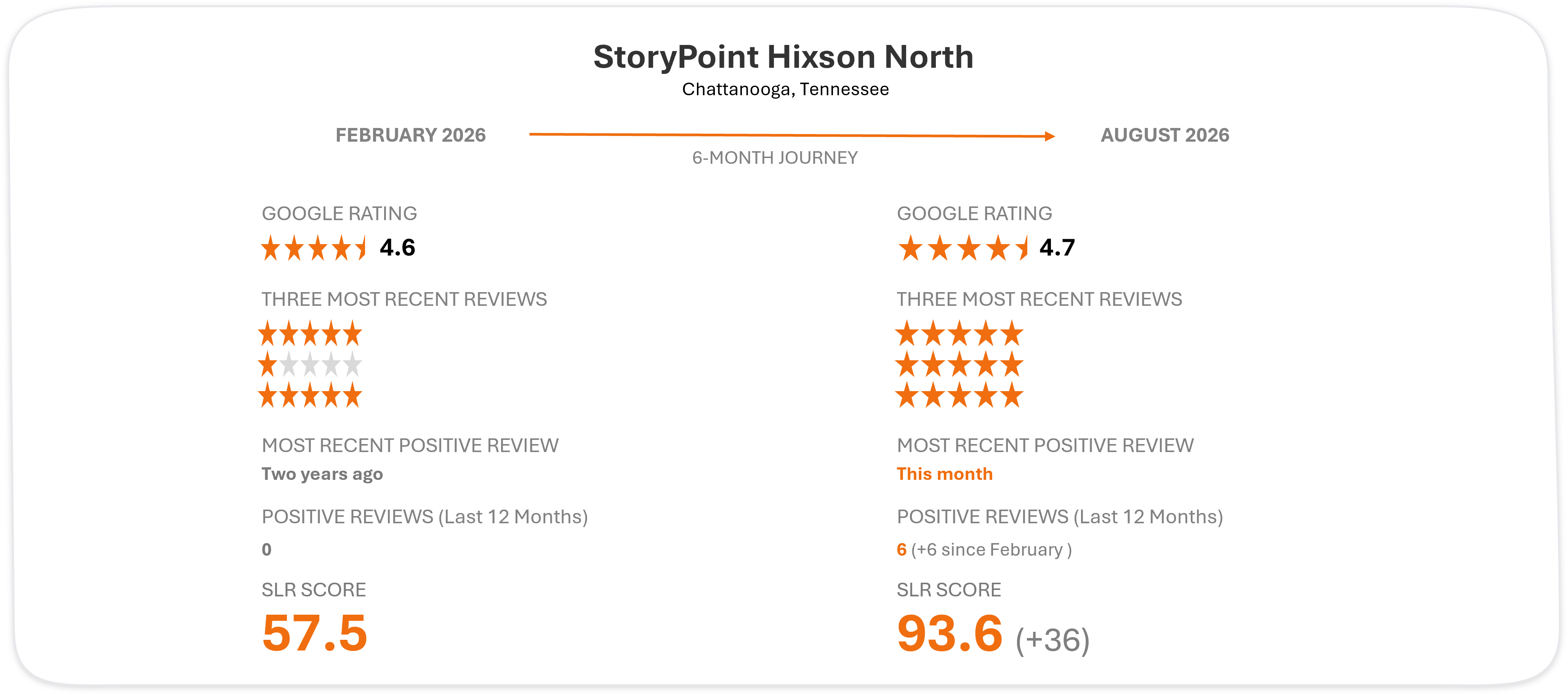
Over the past six months, the community's Google rating improved only slightly, from 4.6 to 4.7 stars.
At first glance, that doesn't appear particularly dramatic.
Looking beneath the surface tells a much different story.
During that same period:
Looking only at the Google rating you would only notice the 4.7 rating, but for families looking deeper they see a community that has combined years of accumulated experiences with positive reecent momentum.
Grace Commons reached a similar destination, but through a slightly different path.
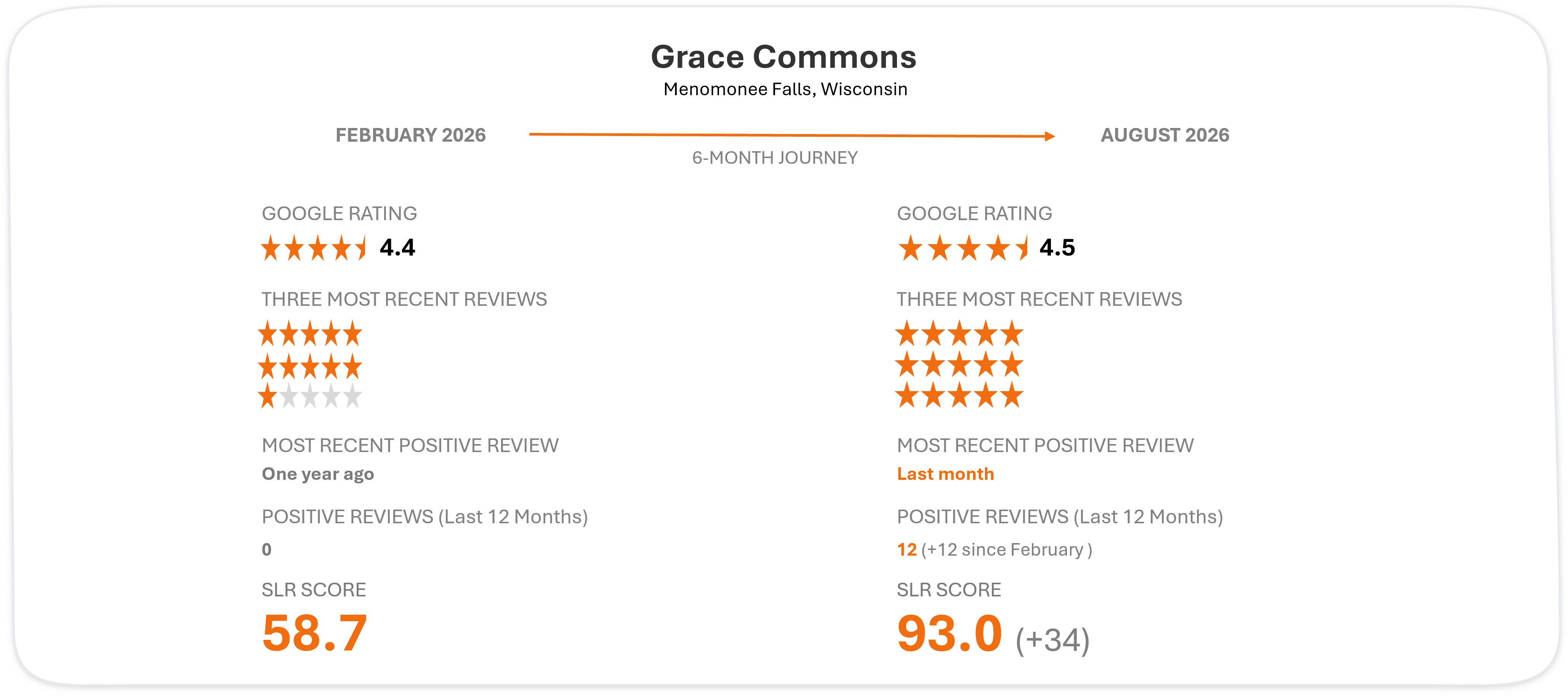
Its Google rating also changed only modestly, moving from 4.4 to 4.5 stars.
Again, the overall rating suggests relatively little has changed.
The underlying activity tells a much bigger story.
Over the six-month period, the community generated 12 positive Google reviews, taking it from no positive reviews within the previous 12 months to one of the strongest recent review-generation performances in our dataset.
Combined with three recent 5-star reviews, that surge of new positive feedback drove the community's SLR Score from 58.7 to 93.0.
Like StoryPoint of Hixson North, the operational momentum far outpaced what the overall Google rating alone would suggest.
Of course, reputation momentum doesn't always move in a positive direction.
The same timing difference can work in reverse.
Consider Heritage Place at Fredericksburg.
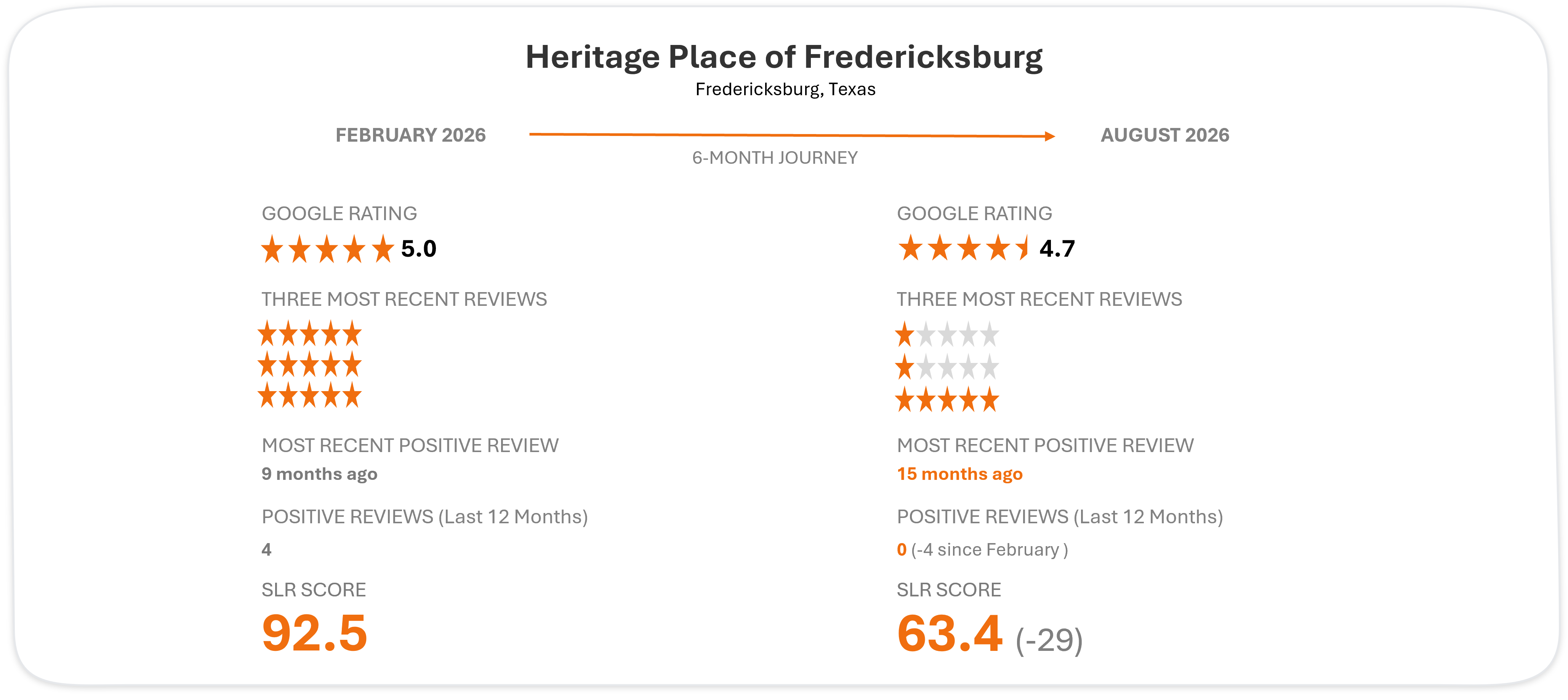
Six months ago, the community held a perfect 5.0-star Google rating.
Today, it remains an impressive 4.7 stars.
On its own, that number tells only part of the story. Looking deeper reveals important context.
Since the community's last positive review, Google has received two consecutive 1-star reviews.
Because Google can display the newest reviews first, those are among the first experiences prospective residents and families may see. While they reduced the overall rating only modestly (from 5.0 to 4.7) they have a disproportionate influence on how someone perceives the community today.
At the same time, the community has not received a positive review in more than 15 months. As older positive reviews naturally aged beyond our rolling 12-month measurement window, its count of recent positive reviews declined from 4 to 0—another indication that positive momentum had stalled.
None of this suggests the community suddenly became a poor community. Rather, it highlights why recent review activity deserves attention alongside the overall Google rating.
These three communities demonstrate two equally important truths.
Communities that improve resident experience often begin seeing those improvements reflected in recent reviews long before their overall Google rating changes significantly.
Likewise, slowing review generation or emerging negative sentiment can begin changing the context surrounding an otherwise excellent Google rating.
Neither means the Google rating is wrong.
In fact, its cumulative nature is one of its greatest strengths.
It captures a community's long-term reputation.
But understanding what's happening today requires looking beyond that single number to also consider
Together, those signals reveal something equally important: momentum.
At Senior Living Reputation, that's exactly why we developed the Senior Living Reputation (SLR) Score.
Rather than relying solely on a cumulative Google rating, the SLR Score combines four key indicators—overall rating, review recency, review generation, and recent review trend—to provide a more complete picture of a community's current online reputation.
Google ratings tell the story of where a community has been.
Recent review activity helps explain how a community's reputation is perceived today.
Understanding both provides the clearest picture of a community's online reputation.
Our January 2026 Senior Living Reputation Leaderboard highlights the Top 10 brands based on portfolio-wide reputation performance, along with key month-over-month shifts that show where momentum is building — and why it matters.

The April Senior Living Reputation Leaderboard shows continued stability among top-performing brands, but a widening middle. Reputation leadership is becoming less about standout communities and more about consistent performance across entire portfolios.